TCP vs UDP: The Internet's Delivery Services Explained
The Internet’s Shipping Problem
Imagine you need to send 100 books to a friend. You have two shipping options:
Option A (TCP): The courier checks each book, confirms delivery, and resends any lost books. Slow but guaranteed.
Option B (UDP): You throw books out of the window hoping your friends catches them. Fast but unreliable.
This is exactly how data travels online. TCP and UDP are the internet’s “shipping methods“ for data packets/
Meet TCP: The Reliable Courier
What is TCP?
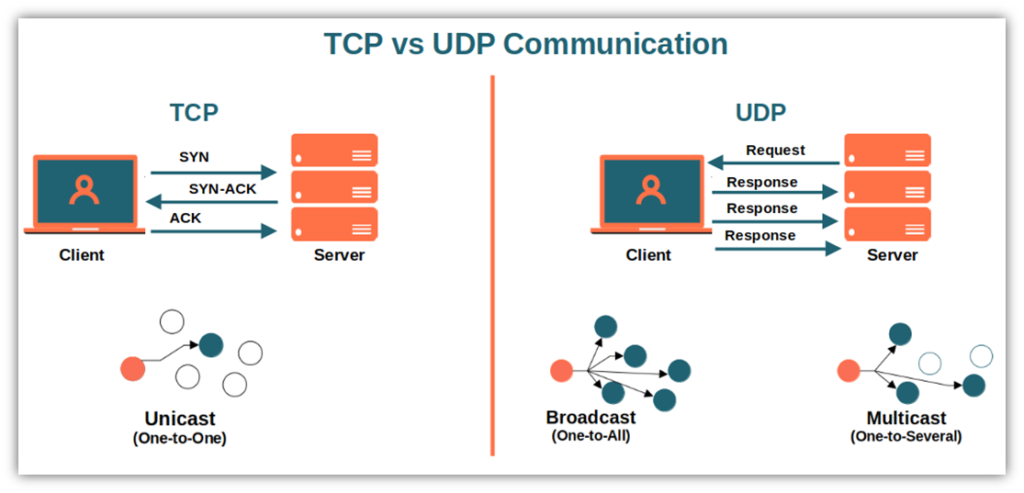
TCP (Transmission Control Protocol) is like phone call or registered mail. It guarantees delivery.
How TCP Works:
Connection Setup: “Hello, can you hear me?“ → “Yes, I can!“ (Three - Way Handshake)
Reliable Delivery: Every packet is numbered and acknowledged.
Error Checking: If data gets corrupted, it is resend.
Order Guarantee: Data arrives in the correct order.
Flow Control: “Slow down, I can not handle that much“
Meet UDP: The Fast Messenger
What is UDP?
UDP (User Datagram Protocol) is like a shout in a crowded room or live TV broadcast. Fast but not guarantees.
How UDP Works:
No Connection: Just sends data immediately.
No Acknowledgement: Does not check if data arrived.
No Re-Transmission: Lost packets stay lost.
No Ordering: Packets may arrive out of order.
Fire And Forget: Send data and hopes for the best.
Key Differences at a Glance
| Feature | TCP | UDP |
| Connection | Connection-Oriented (Handshake) | Connection-less (No Handshake) |
| Reliability | Guaranteed Delivery | Best-Effort Delivery |
| Ordering | Maintains Packet Order | No Ordering Guarantees |
| Speed | Slower (Due to overhead) | Faster (Minimal overhead) |
| Error Checking | Extensive Checks and retires | Basic checksum only |
| Use cases | When accuracy matters | When speed matters |
| Analogy | Phone call, registered mail | Shouting, live broadcast |
When to use TCP: The “Better Safe Than Sorry“ Choice
Use TCP When:
Data must arrive perfectly: Web pages, emails, file downloads.
Order matters: Database transactions, financial data.
You can tolerate slight delays: Most web applications.
Real-World TCP Examples:
- Web Browsing (HTTP/HTTPS)
You -> "GET google.com" -> TCP ensures page loads completely
- Email (SMTP)
Your email -> TCP gurantees delivery -> Recipient's inbox
- File Transfers (FTP)
File chunks -> TCP verifies each chunk -> Complete file
- Remote Desktop (SSH/RDP)
Key strokes -> TCP ensures every key arrives -> Remote computer
When to use UDP: The “Speed is everything“ choice
Use UDP When:
Real time data is crucial: Video calls, online games
Small losses are acceptable: Missing a video frame is okay.
Broadcasting to many: Live streaming, DNS queries.
Speed > Perfection: Voice calls, sensor data.
Real World UDP Examples:
- Video Streaming (YouTube, Netflix)
Video packets -> UDP sends rapidly-> Your screen
[ Missing a few frames? keep playing ]
- Online Gaming (Fortnite, Call of Duty)
PLayer position -> UDP sends 60 times/sec -> Game server
[ LOst packet? Estimate position and continue ]
- Voice calls (Zoom, Discord)
Your voice -> UDP send immediately -> Other person
[ Small glitch? "Can you repeat that" ]
14 DNS Lookups
"google.com?" -> UDP Query -> DNS Server -> "142.250.190.78"
[ If no response, ask another server ]
- IoT Sensors
Temperature data -> UDP sends every second -> server

[ MIssing 1 reading? 99 others are coming ]
HTTP: The Application Layer on Top
What is HTTP?
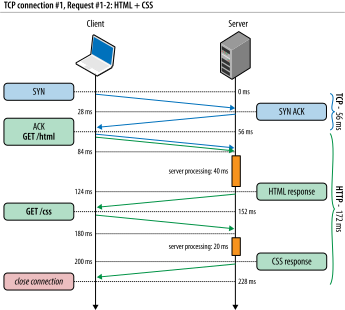
HTTP (Hypertext Transfer Protocol) is what you say, while TCP is how you say it.
Simple Analogy:
TCP = The telephone line (connection)
HTTP = The language you speak (content)
The Protocol Stack: How Everything Fits Together
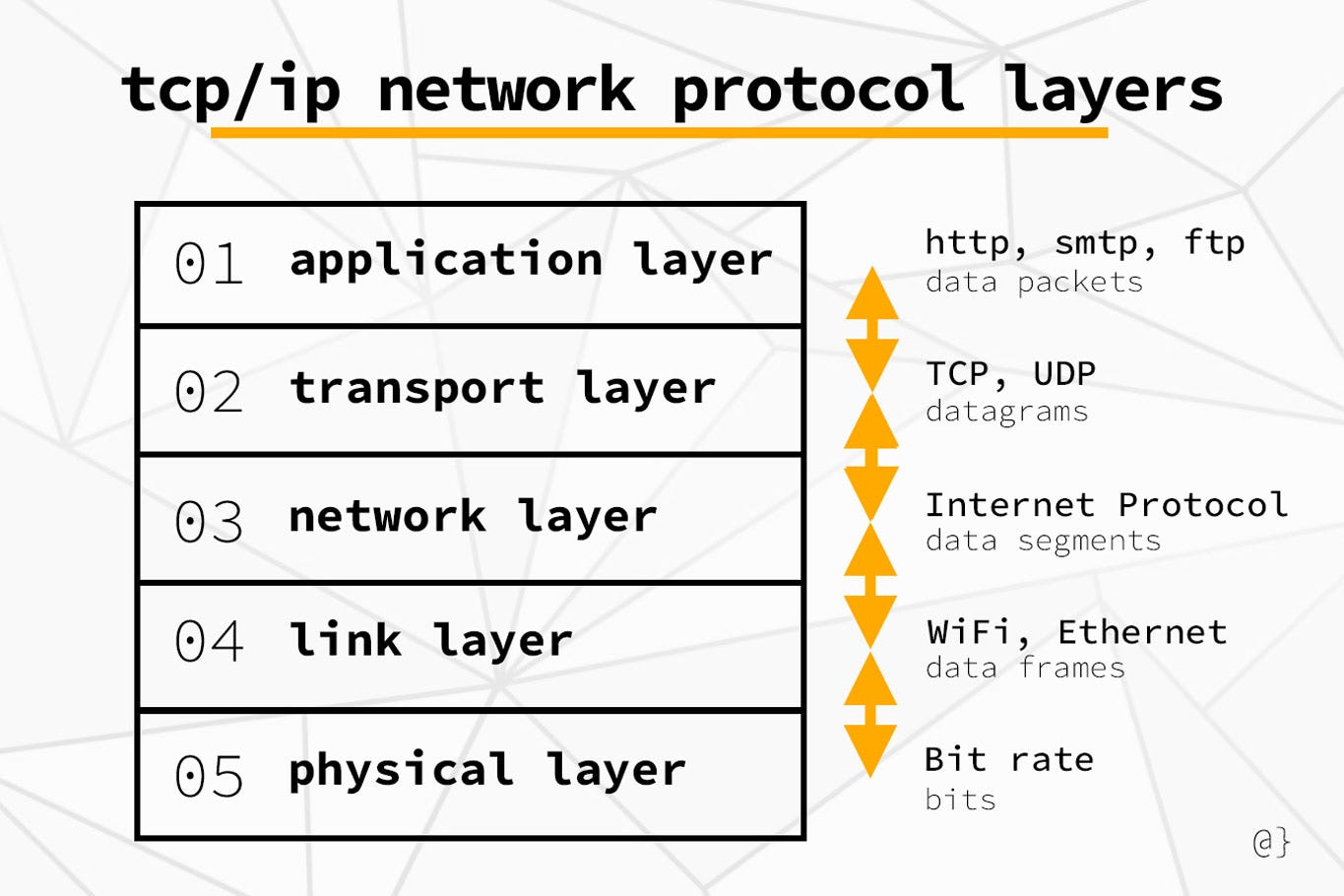
Simplified Internet Layers:
Common Questions Answered?
- Is HTTP the same as TCP?
NO, HTTP is the message (like a letter’s content), TCP is the delivery service (like postal system).
- Can HTTP work without TCP?
Currently, HTTP requires TCP (or a TCP-like reliable transport). HTTP/3 uses QUIC over UDP, but still adds reliability.
- Why does not HTTP replace TCP?
Because HTTP is application-level (what), TCP is transport-level (how). Other protocols (like email, FTP) also uses TCP.